
Blinatumomab (Blincyto)
Updated September 2026.
Also known as: Blincyto, blina
Holds one of your kid's own immune cells against a leukemia cell so the immune cell can kill it. Runs as a continuous drip.
Research reviewed September 16, 2026. U.S. treatment and approval context.
What it is
Blina is a laboratory-made protein used to treat B-cell acute lymphoblastic leukemia (B-ALL), a cancer involving immature B cells. It is an immunotherapy, meaning it recruits part of the body’s immune system to fight cancer—in this case, immune cells called T cells. It helps those T cells attack cells carrying CD19, a protein on many B-ALL cells and on healthy B cells too.1,2
Deeper dive
B cells and T cells are both white blood cells. Healthy B cells help fight infection by making antibodies, while T cells have other protective jobs, including destroying abnormal cells.2
The care team checks which proteins the leukemia cells carry. CD19-positive means the cells have the protein Blina needs to attach to; CD19 is not a label found only on cancer cells.1
How it works
Blina acts as a temporary link between a T cell and a cell carrying CD19. This close contact helps activate the T cell, which can then destroy the attached cell. Blina does not carry chemotherapy into the target cell; it recruits the T cell to do the killing.2,3
Deeper dive
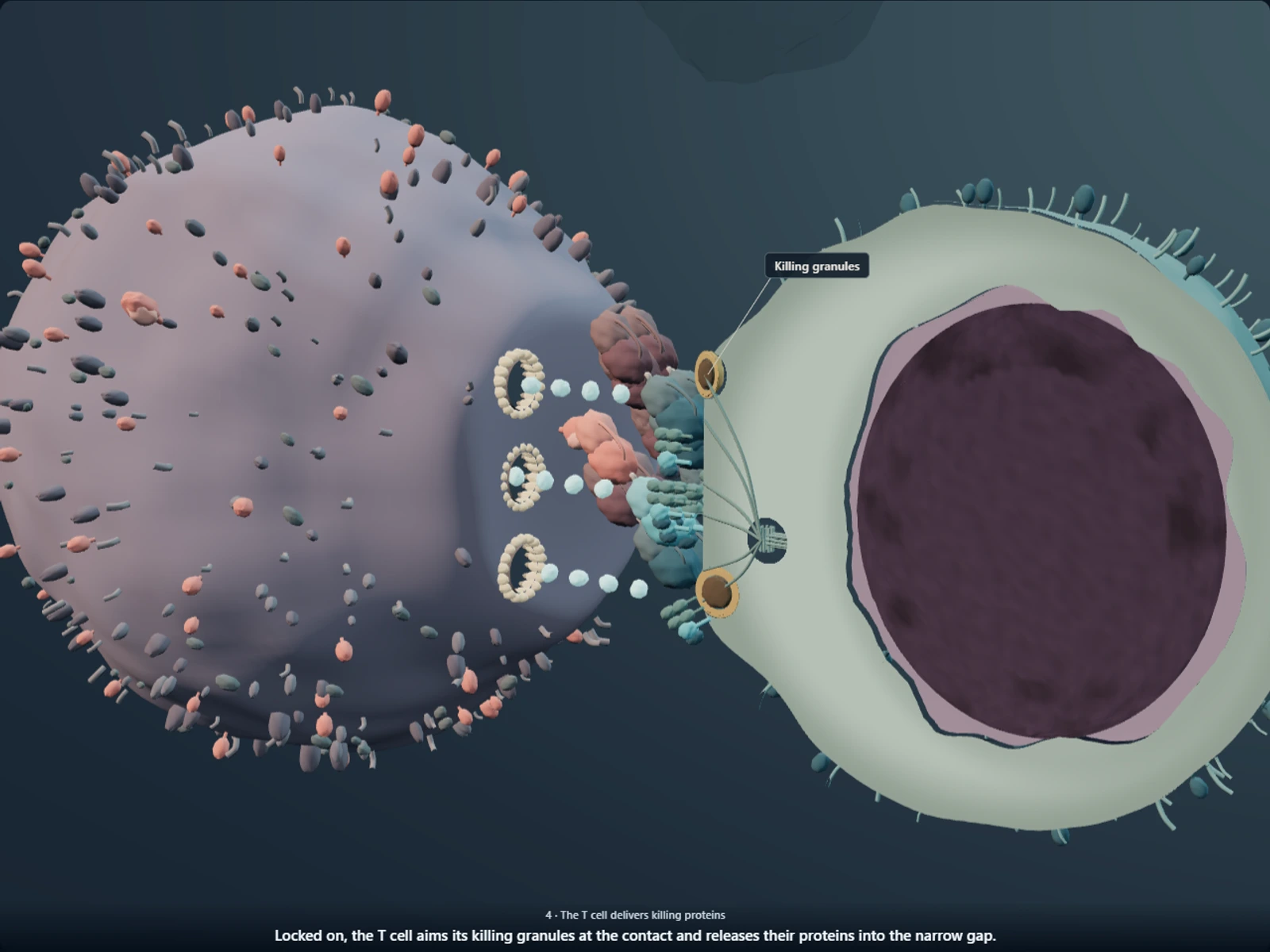
The T-cell end of Blina attaches to a protein called CD3, which is part of the T cell’s activation machinery. Once activated, the T cell releases proteins that damage the target cell and trigger its death.1,3
Blina leaves the bloodstream relatively quickly, so treatment uses a continuous infusion through a vein, delivered by a pump.1 A treatment cycle often includes 28 days of infusion; the team sets the exact schedule and monitoring plan.4 Many children begin in hospital and continue at home when their team says it is safe.5
I made an everyday analogy and a more scientific visualization of blinatumomab.
Everyday analogy
Blinatumomab: a connector that brings a T cell close
1 / 3 A different symbol
The worker passes a house with a different symbol.
2 / 3 The connector brings them together
The teal connector locks on and brings the worker close.
3 / 3 The worker knocks the house down
Connected to the matching house, the worker knocks it down.
Teal connector = blinatumomab. It connects a T cell to a cell with the matching marker and helps the T cell attack.
The worker represents a T cell, an immune cell that can kill other cells. The houses represent cells; the worker does the demolition, not the connector.
The matching diamond represents CD19, a marker found on B-cell leukemia cells and on some healthy B cells. It is not a cancer-only label.
The house with the different symbol is not connected or knocked down in this scene. The reel is a visual way to show the two cells being brought close, not a literal motor.
Press play below for a more accurate visualization.
Interactive visual
How blinatumomab connects a T cell to a leukemia cell
When it may be used
Blina may be part of a child’s first course of B-ALL treatment, or it may be used when leukemia remains or returns. Relapsed means the leukemia has come back; refractory means it has not responded adequately to treatment.1,2 Sometimes Blina helps prepare a child for a donor stem-cell transplant, which replaces blood-forming cells, but receiving Blina does not automatically mean a transplant is planned.6,7,2
Deeper dive
In complete remission, the usual checks no longer show signs of leukemia, but some leukemia cells may remain. More sensitive tests can sometimes find very small amounts, called measurable residual disease (MRD); this helps the team decide what treatment should come next.8,9
In the United States, Blina is approved for children aged 1 month and older whose B-ALL cells carry CD19. Approved settings include certain cases with MRD during remission, and leukemia that has returned or resisted treatment. It is also approved during consolidation—a phase that strengthens the initial treatment response—for B-ALL without a particular leukemia-cell genetic change called the Philadelphia chromosome.1,10 Children can receive it during consolidation even when an MRD test finds no leukemia.10
A block of Blina given without the usual multi-drug chemotherapy at the same time is not the same as an entirely chemotherapy-free treatment plan. For example, the lower-risk relapse plan in AALL1331 did not include a planned transplant, but it still included chemotherapy.7 Blina also does not replace treatment directed at leukemia in the fluid around the brain and spinal cord.1
St. Jude’s Total XVII study incorporated Blina into first treatment for selected children, including those with concerning test results or difficulty tolerating chemotherapy. Its conference report focused on whether this could be delivered safely, not on proving a survival advantage.11 Studies such as St. Jude’s SJALL23H continue to test how Blina fits with other medicines.12 Your child’s plan depends on the leukemia’s features, its response to treatment, and what your child can safely receive.9,11
How well it works
Adding Blina to chemotherapy improved results in AALL1731, a study of selected children receiving their first B-ALL treatment in two groups: standard-risk average (SR-Average) and standard-risk high (SR-High).9,13 The headline percentages below combine children grouped by leukemia features and early treatment response; they simplify many different situations into one estimate.9 Statistics matter enormously because they help show which treatments work, yet for a parent the outcome that matters most is what happens to their own child—and a group percentage cannot tell that story in advance.
One trial. Two looks over time.
Selected children in SR-Average + SR-High. Both reports compare adding Blina to chemotherapy with chemotherapy alone.
3 years
Full paper · online Dec 2024
NEJM journal issue · Feb 2025
Alive without relapse or a second cancer
Read the three-year paper ↗4 years
Conference update · ASH 2025
Presented by Dr. Sumit Gupta
Alive without relapse or a second cancer
Read the four-year abstract ↗“Years” means time after treatment-group assignment. It is not the year the paper was published. These are estimates from two analyses of the same trial, not two separate trials or a drawn survival curve.
Why can the later percentage be lower?
A child counted as disease-free at three years can have an event before four years. For the same patients followed from the same starting point, disease-free survival stays level or falls as events accumulate; more follow-up does not make it rise. These reports also use updated analyses, so subtracting the two estimates would not give the exact number of events in year four.
The hope for future children is different: treatment advances may improve outcomes in future groups. That is a reason for hope, not a promise that this trial’s percentages will rise. NCI: understanding survival statistics.
The earlier analysis included 1,440 randomized children, with median follow-up of 2.5 years. The update reports 1,444 and median follow-up of 3.5 years; 133 were censored when crossover to Blina was offered. Not every child had reached the headline follow-up time. Paper · Update
Bars use the same 0–100% scale. ± shows the reported standard error: uncertainty in a group estimate, not a child’s personal range. Disease-free survival is not a guarantee of cure.
Which group are we looking at?
The relapse studies answer a different question from first treatment. Explore each group on its own; their percentages are not a ranking.
First relapse · transplant intended
2-year disease-free survival
The estimates favored Blina, but the trial ended early and did not meet its preset standard for a clear disease-free-survival benefit. Two-year overall survival was 71.3% with Blina versus 58.4% with chemotherapy. Study source ↗
The statistical detail, explained
Researchers set a threshold for how strong the evidence must be before calling a difference clear. A P value describes how compatible the data are with a model of no treatment difference; it is not the chance a treatment will work for your child, or the probability the finding is “just chance.”
The primary test used a one-sided P value: .03, above the required threshold of .025. The hazard ratio was 0.70 (95% confidence interval 0.47–1.03). The early stop limits how firmly this result can be interpreted.
First relapse · lower-risk group
4-year disease-free survival
The whole-group result did not establish a clear benefit. Where the leukemia returned mattered: explore the next two groups to see why one overall number can hide important differences. Study source ↗
The statistical detail, explained
Researchers set a threshold for how strong the evidence must be before calling a difference clear. A P value describes how compatible the data are with a model of no treatment difference; it is not the chance a treatment will work for your child, or the probability the finding is “just chance.”
The reported P value for disease-free survival was .089. The abstract prints the ± values without defining them there; they are preserved here without interpreting them as confidence intervals.
First relapse · in the bone marrow
4-year disease-free survival
A benefit was detected when relapse involved the bone marrow, whether or not other sites were involved too. This is one part of the lower-risk trial, not its overall result. Study source ↗
The statistical detail, explained
Researchers set a threshold for how strong the evidence must be before calling a difference clear. A P value describes how compatible the data are with a model of no treatment difference; it is not the chance a treatment will work for your child, or the probability the finding is “just chance.”
The reported P value for disease-free survival was .015. Four-year overall survival was 97.1±2.1% versus 84.8±4.8% (P=.020). Blina-containing treatment is listed first.
First relapse · outside the marrow only
4-year disease-free survival
A clear benefit was not detected in this subgroup. The slightly lower Blina estimate does not establish that Blina was worse. These children had relapse outside the marrow, such as in the fluid around the brain and spinal cord. Study source ↗
The statistical detail, explained
Researchers set a threshold for how strong the evidence must be before calling a difference clear. A P value describes how compatible the data are with a model of no treatment difference; it is not the chance a treatment will work for your child, or the probability the finding is “just chance.”
The reported P value for disease-free survival was .62. This comparison did not establish a difference between the treatment groups.
Time starts at randomization after initial relapse treatment. The higher-risk pathway intended transplant; the lower-risk pathway retained chemotherapy without a planned transplant. Definitions and treatment plans differ from AALL1731. 6 · 7
Deeper dive: the children behind the numbers
What do those risk “buckets” mean? Children first met the study’s standard-risk definition: age 1 to under 10, with a white blood cell count below 50,000 per microliter at diagnosis. Leukemia genetics and response to initial treatment then separated them into smaller groups, including SR-Average and SR-High; “SR-High” means higher relapse risk within that initial standard-risk category. The comparison excluded the SR-Favorable group and some SR-Average children whose sensitive tests found no remaining leukemia, so even “all standard-risk children” would be too broad a description.9
The separate risk groups, at three years. In the earlier full paper, disease-free survival was 97.5±1.3% with Blina plus chemotherapy versus 90.2±2.3% with chemotherapy alone in SR-Average. For SR-High, the figures were 94.1±2.5% versus 84.8±3.8%. These are three-year estimates with standard errors, not a breakdown of the four-year update; both groups benefited.9
Another view of the four-year update: relapse. The estimated four-year rate of leukemia returning was 4.4±0.9% with Blina versus 12.6±1.5% without it. That is a different measure from disease-free survival, which also counts death or a second cancer as events. These are estimates from the ASH 2025 conference update, with ± standard errors; they are not individual predictions.13
How it was developed
Blina grew from laboratory work on antibody proteins that could attach to two different cells at once. Researchers including Gert Riethmüller, Peter Kufer, and Ralf Bargou helped develop this approach, and the biotechnology company Micromet took it into drug development.15,3,16 Amgen acquired Micromet in 2012 and now markets Blincyto, which first received U.S. approval in 2014.17,1
Decades of work.
A changing treatment story.
Discovery, drug approval and trial results are different milestones. Follow the thread.
- 1995Discovery
A small protein with two targets
Early laboratory work establishes a compact antibody that can connect two different targets. It is not yet the CD19-targeting drug.
Original laboratory paper ↗ - 2000Discovery
The CD19–CD3 connection
Researchers show that this antibody design can direct T cells against B-cell lymphoma cells in the lab.
Löffler and colleagues ↗ - 2003–09Development
From a platform to a medicine
Micromet partners with MedImmune in 2003 and regains worldwide rights in 2009. A 2008 study reports responses in adults with lymphoma.
Company record ↗ · Research paper ↗ - 2012Development
Amgen acquires Micromet
Blina joins Amgen through the acquisition; its scientific story began before Amgen owned it.
Amgen history ↗ - 2014FDA milestone
First U.S. approval
The initial approval is for relapsed or refractory Philadelphia chromosome-negative B-cell precursor ALL.
FDA approval history ↗ - 2016FDA milestone
Pediatric labeling expands
August 30: the FDA expands the indication to pediatric patients with Philadelphia chromosome-negative relapsed or refractory B-cell precursor ALL. This is a drug milestone, not AALL1731’s start.
FDA pediatric record ↗ - 2018FDA milestone
An approval for remaining disease
The FDA adds use for certain adults and children in remission who still have measurable residual disease (MRD).
FDA announcement ↗ - 2019AALL1731
The frontline trial opens
June 28: AALL1731 begins enrolling children. It asks whether adding Blina to chemotherapy improves outcomes in selected newly diagnosed standard-risk B-ALL.
Trial investigators’ report ↗ - 2021–23Pediatric evidence
Results after first relapse
AALL1331 reports higher/intermediate-risk results in 2021 and lower-risk results in 2023. The groups and treatment pathways are different.
2021 paper ↗ · Research paper ↗ - Jun 2024FDA milestone
Consolidation approval expands
June 14: approval expands to consolidation within multiphase chemotherapy for CD19-positive, Philadelphia chromosome-negative B-ALL, including children one month and older. This predates the AALL1731 results presentation.
FDA announcement ↗ - Dec 2024AALL1731
The three-year results arrive
The findings are presented at ASH and published online in NEJM. The print issue follows in February 2025—one report with two publication dates.
Three-year report ↗ - 2025AALL1731
A longer look: four years
At ASH, Dr. Sumit Gupta presents updated follow-up. The benefit remains; this is the conference abstract behind the four-year graphic above.
Four-year update ↗
AALL1731 is a clinical trial, not a medicine with an FDA approval date. The verified milestone here is its June 2019 enrollment start; a separate protocol-approval date has not been established.
Deeper dive
A 1995 laboratory paper helped establish the idea of a small, two-target antibody protein; it was not yet the CD19-targeting medicine used today.15 A 2000 paper by Löffler and colleagues then showed that a CD19/CD3 antibody could direct human T cells against B-cell lymphoma cells in the laboratory—an important step toward Blina, but not yet evidence from children receiving treatment.3
Micromet partnered with MedImmune in 2003 and regained worldwide rights to Blina in 2009.16 A landmark 2008 paper in Science reported tumor responses in adults with non-Hodgkin lymphoma, showing that this T-cell-linking strategy could work in patients.18 Those early results came from a different cancer and age group; the childhood B-ALL studies described above answered later questions about how to use Blina in children.
Sources
All sources below were checked for this page on September 16, 2026. Conference reports are identified separately from full research papers.
1. Amgen. BLINCYTO (blinatumomab): U.S. Prescribing Information. Revised April 2026. See indications (§1), administration (§2), and mechanism of action (§12.1). Full prescribing information.
2. National Cancer Institute. Childhood Acute Lymphoblastic Leukemia Treatment (PDQ®)—Patient Version. See general information and immunotherapy. Patient information.
3. Löffler A, Kufer P, Lutterbüse R, et al. A recombinant bispecific single-chain antibody, CD19 × CD3, induces rapid and high lymphoma-directed cytotoxicity by unstimulated T lymphocytes. Blood. 2000;95(6):2098–2103. Laboratory study. Original paper record and abstract.
4. Amgen. BLINCYTO (blinatumomab): FDA-approved Medication Guide. Revised April 2025; current version accessed September 16, 2026. Medication Guide.
5. Together by St. Jude™. Blinatumomab. Information for patients and families. Medicine guide.
6. Brown PA, Ji L, Xu X, et al. Effect of Postreinduction Therapy Consolidation With Blinatumomab vs Chemotherapy on Disease-Free Survival in Children, Adolescents, and Young Adults With First Relapse of B-Cell Acute Lymphoblastic Leukemia: A Randomized Clinical Trial. JAMA. 2021;325(9):833–842. AALL1331 higher-/intermediate-risk report. doi:10.1001/jama.2021.0669. Full paper hosted by SEHOP.
7. Hogan LE, Brown PA, Ji L, et al. Children’s Oncology Group AALL1331: Phase III Trial of Blinatumomab in Children, Adolescents, and Young Adults With Low-Risk B-Cell ALL in First Relapse. Journal of Clinical Oncology. 2023;41(25):4118–4129. doi:10.1200/JCO.22.02200. Original abstract reproduced on ResearchGate.
8. National Cancer Institute. Dictionary of Cancer Terms. Entries for remission and minimal residual disease.
9. Gupta S, Rau RE, Kairalla JA, et al. Blinatumomab in Standard-Risk B-Cell Acute Lymphoblastic Leukemia in Children. New England Journal of Medicine. 2025;392:875–891; first published online December 7, 2024. Full AALL1731 three-year report. doi:10.1056/NEJMoa2411680. Full-paper copy available through ResearchGate.
10. U.S. Food and Drug Administration. FDA approves blinatumomab as consolidation for CD19-positive Philadelphia chromosome-negative B-cell precursor acute lymphoblastic leukemia. June 14, 2024. Approval announcement.
11. Duffy C, Dang E, Zhou Y, et al. Safety and Feasibility of Blinatumomab As Frontline Therapy for Pediatric Patients with B-Acute Lymphoblastic Leukemia and Lymphoma: St. Jude Total Therapy Study XVII. Blood. 2024;144(Supplement 1):4208. ASH conference abstract and poster, not a full efficacy paper. doi:10.1182/blood-2024-209284. Abstract. Poster.
12. St. Jude Children’s Research Hospital. SJALL23H: Treatment of High-Risk Leukemia/Lymphoma. Clinical-trial description, accessed September 16, 2026. Study information.
13. Gupta S, Rau R, Kairalla J, et al. Blinatumomab mitigates the impact of traditional adverse prognosticators among children with standard risk B-acute lymphoblastic leukemia: Updated results of the Children’s Oncology Group (COG) Trial AALL1731. Blood. 2025;146(Supplement 1):758. ASH 2025 conference abstract; four-year update. doi:10.1182/blood-2025-758. Complete abstract reproduced in coauthor Rachel Rau’s Seattle Children’s publication profile.
14. Schrappe M, Locatelli F, Valsecchi MG, et al. Replacement of high dose combination chemotherapy with blinatumomab in newly diagnosed pediatric high-risk B-cell ALL improves efficacy and safety in the randomized phase 3 AIEOP-BFM ALL 2017 trial. HemaSphere. 2026;10(S1), abstract S103. EHA 2026 conference report. Official abstract PDF. EHA presentation record.
15. Mack M, Riethmüller G, Kufer P. A small bispecific antibody construct expressed as a functional single-chain molecule with high tumor cell cytotoxicity. Proceedings of the National Academy of Sciences of the USA. 1995;92(15):7021–7025. Early platform research, not the later CD19-targeting clinical drug. doi:10.1073/pnas.92.15.7021. Original paper record.
16. Micromet, Inc. Annual Report on Form 10-K for the year ended December 31, 2011. Filed with the U.S. Securities and Exchange Commission in 2012. See Business, including “Collaboration Agreement with MedImmune.” Original SEC filing.
17. Amgen. Amgen History. See the 2012 Micromet acquisition entry. Company history.
18. Bargou R, Leo E, Zugmaier G, et al. Tumor regression in cancer patients by very low doses of a T cell-engaging antibody. Science. 2008;321(5891):974–977. Early clinical evidence in adults with non-Hodgkin lymphoma. doi:10.1126/science.1158545. Original paper record and abstract.
19. National Cancer Institute. Cancer Support Groups. Updated July 26, 2024. Support-group guidance.
Side effects
The full list, kept up to date:
- Blinatumomab — Together by St. Jude · written for families by a children's cancer hospital
- Blinatumomab injection — MedlinePlus · U.S. National Library of Medicine