Written by a parent, not a doctor. Nothing here is medical advice.

Medicine

Cytarabine (ara-C)

Updated September 2026.

Also known as: ara-C, Cytosar

Fakes a DNA building block so dividing leukemia cells cannot copy themselves. Often given as a run of shots.

Cytarabine (ara-C) is a look-alike. It is almost identical to cytidine, one of the four building blocks of DNA, with one small change in its sugar. Depending on the phase of treatment it is given as shots under the skin, through the line, or into the spinal fluid.

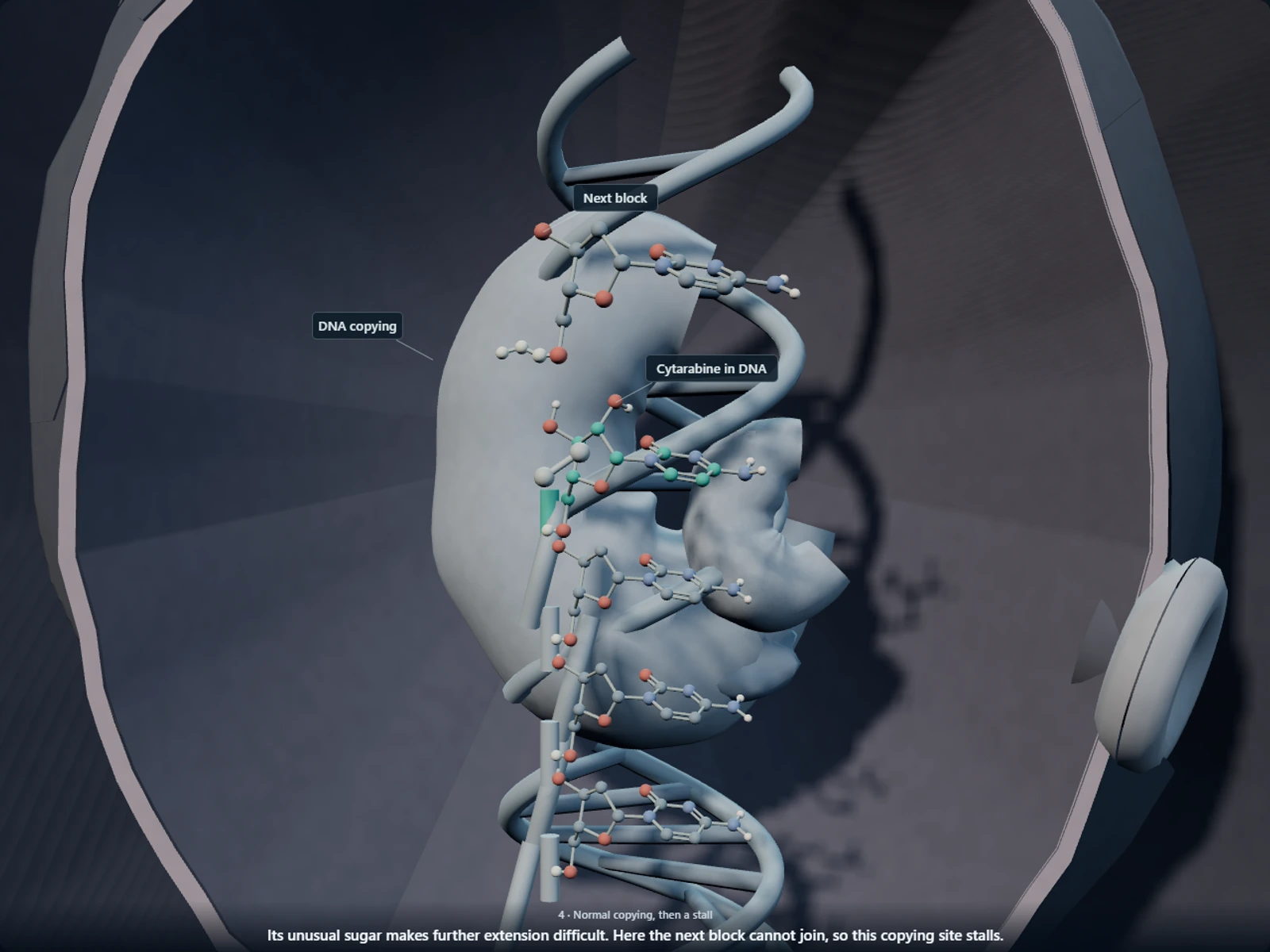
Cells take it up and, treating it as the real thing, build it into the growing DNA copy. Once the fake block is in place the copying machinery cannot add the next one properly and the chain stalls. A cell stuck halfway through copying its DNA dies. Cells that are not dividing barely notice it, which is why it matters most to leukemia cells.

I made an everyday analogy and a more scientific visualization of cytarabine.

Everyday analogy

Cytarabine: a faulty link leaves the chain unfinished.

Cytarabine: a faulty link leaves the chain unfinished. A workshop machine copies the five-link original chain hanging on the left. Its gripper lifts ordinary links from a supported supply slot, slides each open gate around the end of the growing copy, and closes the gate before letting go. A teal look-alike link is added in the same way, but its lower opening is filled in. The view moves closer while the gripper tries twice to attach the next ordinary link; it cannot pass through the blocked end. The view widens again. The unused link is returned to its supply, the support pin retracts, and the still-connected unfinished chain falls and folds into the lined tray marked Unfinished. The original remains complete and hanging. The tray is a visual ending to the analogy, not a literal process inside a cell. The chain does not rust or break. Original chain New copy LINKS Copying Stopped Blocked end UNFINISHED The machine copies a chain, adding ordinary links one by one. A faulty teal link goes in, but the next link cannot attach. The copy cannot be finished. It drops into the unfinished tray.

1 / 3 Copy the original chain

The machine copies a chain, adding ordinary links one by one.

  • The teal link represents the altered building block formed from cytarabine inside a cell. It can become part of DNA and interfere with further copying.

  • The original chain is the pattern. Making a matching chain is like copying DNA, the cell’s instructions.

  • The unfinished chain shows a failed copying job. A cell may die when it cannot finish copying its DNA. The tray is only part of the analogy.

Press play below for a more accurate visualization.

Interactive visual

How cytarabine disguises itself as a DNA building block and jams the copier
Poster for How cytarabine disguises itself as a DNA building block and jams the copier
Read transcript

## 0–8 seconds: Arrival from the blood Blood carries cytarabine through this vessel to a leukemia cell, so treatment can reach the bone marrow. ## 8–25 seconds: A close imitation, then entry Cytarabine resembles a normal DNA ingredient, but its sugar carries an extra hydroxyl group. A membrane transporter carries this look-alike inside, using the same route as normal nucleosides. ## 25–49 seconds: Activation inside the cell Inside the cell, enzymes prepare cytarabine by adding phosphate groups one at a time. The same molecule moves between enzymes: one phosphate becomes two, then three. With three phosphates attached, activated cytarabine is called ara-CTP. The DNA copier can now use it. Ara-CTP can pass through a nuclear pore, reaching the DNA inside. ## 49–86 seconds: Normal copying, then a stall The DNA copier reads the existing strand and joins matching building blocks into a new strand. Each normal block joins the growing strand, so the copier can move on and add another. Ara-CTP also fits the copier and is added to the growing DNA strand. Its unusual sugar makes further extension difficult. Here the next block cannot join, so this copying site stalls. Many stalled copying sites can leave DNA unfinished. This is not an instant stop at every cytarabine molecule. ## 86–96 seconds: Damage activates self-destruction When unfinished DNA causes too much damage, the cell can activate its self-destruct program. Mitochondria release a signal, so caspases activate and dismantle the cell from inside. ## 96–108 seconds: Sealed packets and cleanup The damaged cell shrinks into sealed packets, so a cleanup cell can swallow what remains.

Side effects

The full list, kept up to date:

Where I read this