Written by a parent, not a doctor. Nothing here is medical advice.

Medicine

Daunorubicin

Updated September 2026.

Also known as: anthracycline

The red one. Wedges into DNA and traps the enzyme that untangles it. The total amount a child ever gets is counted.

Daunorubicin is an anthracycline, a deep red chemotherapy drug given through the line. It was first isolated from a soil bacterium.

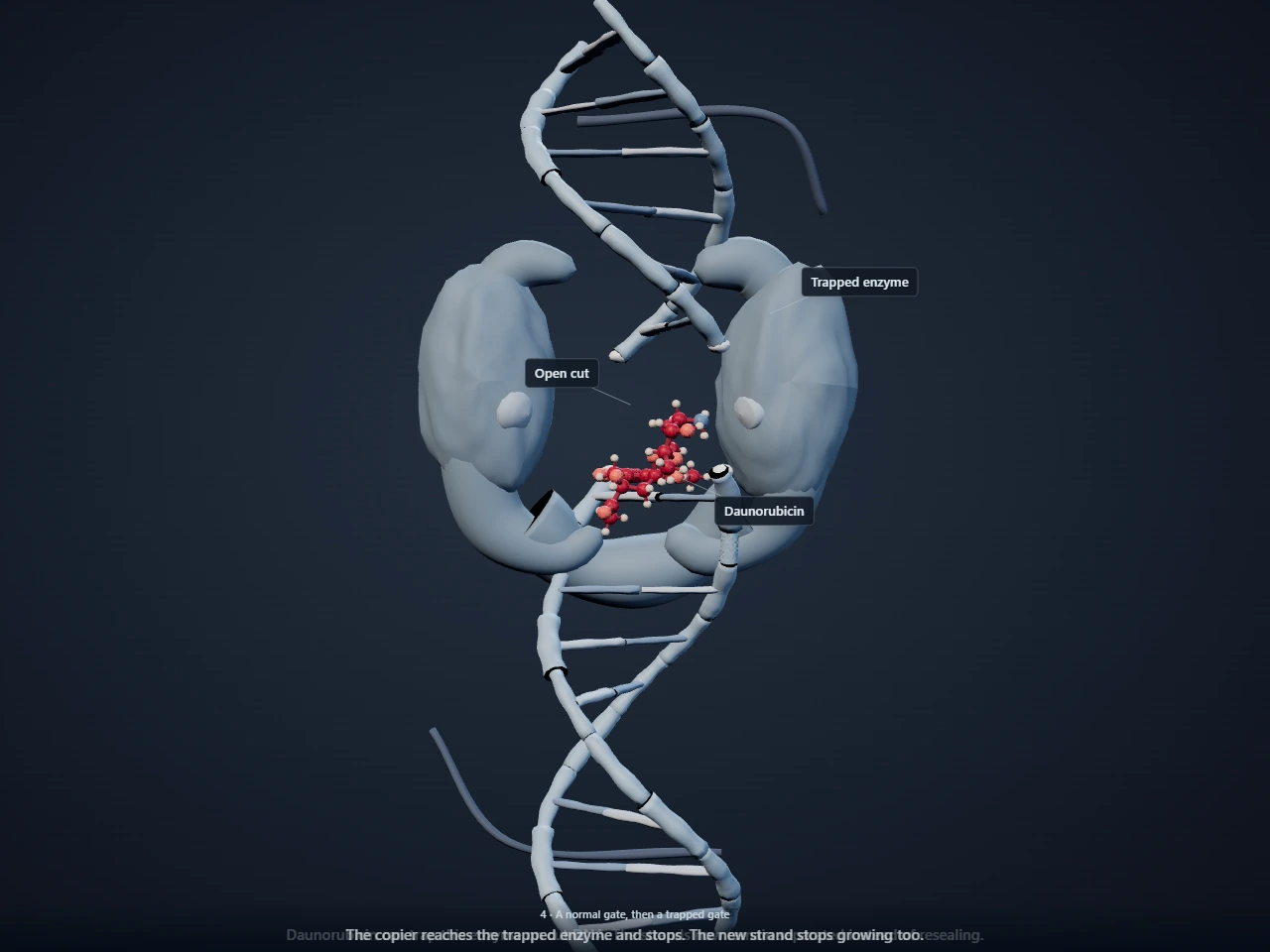
It works on DNA. To copy or read its DNA, a cell has to untangle it, and an enzyme called topoisomerase II does that by cutting one section, passing another through the gap, and sealing the cut. Daunorubicin slides between the rungs of the DNA ladder and freezes the enzyme at the moment it has made the cut, so the cut never gets sealed. A cell with many of these breaks stops dividing and dies. Teams keep a running total of every anthracycline dose a child has ever had (daunorubicin and doxorubicin count together); the side-effect pages linked below explain why.

I made an everyday analogy and a more scientific visualization of daunorubicin.

Everyday analogy

Daunorubicin is like a wedge that stops a tailor sewing a seam closed.

Daunorubicin is like a wedge that stops a tailor sewing a seam closed.A seated tailor with yellow cartoon skin works on a rose-colored shirt. A magnified view shows the same seam, not a second shirt. She holds the sleeve while opening its seam with a seam ripper. She visibly sets down the ripper, picks up a threaded needle, brings the cloth edges together and sews them closed. She lifts brass dressmaking scissors, snips the thread, returns both tools to the bench and gives the repair a small, satisfied smile. She retrieves the ripper and opens the same seam again. After she moves the tool clear, a teal wedge drops into the already-open gap and settles there. Her eyes follow it and her expression changes. She exchanges the ripper for the needle and makes two careful attempts to close the seam; the needle meets the wedge and withdraws without passing through it. She sets the needle down and turns her empty hand upward. The wedge, open seam, tools and tailor remain visible in a held final scene. The teal wedge represents the medicine; the shirt represents DNA; the tailor is like the cell machinery that briefly cuts and rejoins DNA. This illustrates interference with rejoining, not every way the medicine works. THE WORKROOM A tailor’s work The same seam, closer. Sewn closed Still open Teal wedge = medicine The tailor opens a seam,then sews it closed. She opens the seam again.A teal wedge sticks in the gap. She tries to sew it shut,but the seam stays open.

1 / 3 Open, then sew closed

The tailor opens a seam, then sews it closed.

  • The teal wedge represents daunorubicin.

  • The shirt represents DNA, the cell’s instructions.

  • The tailor is like the cell machinery that briefly cuts and rejoins DNA. The wedge shows how daunorubicin can stop a cut from being rejoined.

  • This analogy shows one way daunorubicin works, not everything it does.

Press play below for a more accurate visualization.

Interactive visual

How daunorubicin wedges into DNA and traps the enzyme that untangles it
Poster for How daunorubicin wedges into DNA and traps the enzyme that untangles it
Read transcript

## From blood to marrow 0s — Blood carries daunorubicin through a bone-marrow vessel, so the drug reaches the leukemia cell beside it. ## A core and a sugar arm 8s — Daunorubicin has a broad, flat core and a projecting sugar arm, so its two parts have different shapes. ## Through two boundaries 15s — The flat core mixes with the oily middle of the cell membrane, so daunorubicin can slip between its lipids. 21s — The molecule passes the inner layer into the cell. This enlarged cutaway exposes the lipid tails around its core. 27s — The nucleus has its own boundary. A nuclear pore provides a passage through it. 34s — Daunorubicin passes through the pore into the nucleus, where the DNA sits. ## A normal gate, then a trapped gate 42s — The flat core slides between DNA rungs. Its sugar arm rests along the groove; the molecule does not become DNA. 52s — At another DNA site, topoisomerase II briefly cuts both strands. This gate lets a second DNA segment pass through. 58s — The second DNA segment moves through the open gate, helping untangle DNA before the cell divides. 63s — Normally the enzyme reseals both strands and releases the other segment. It untangles DNA; it does not copy it. 68s — Daunorubicin can trap this enzyme on cut DNA. The strands now remain separated instead of resealing. 74s — The pale cut ends remain held by the trapped enzyme. This persistent obstacle threatens DNA copying. ## Damage switches on cell demolition 80s — A separate copying complex moves along DNA, building a new strand. The warm-coloured strand marks its progress. 85s — The copier reaches the trapped enzyme and stops. The new strand stops growing too. 90s — Unresolved DNA damage can trigger this cell’s self-destruct response. The view returns to the damaged cell. 96s — Mitochondria release a signal, so caspases activate and dismantle the cell from within. ## Sealed away and cleared 102s — The dying cell shrinks into sealed packets, keeping its contents contained. 108s — A cleanup cell wraps and swallows the small packets. This leukemia cell is gone.

Side effects

The full list, kept up to date:

Where I read this