Written by a parent, not a doctor. Nothing here is medical advice.

Medicine

Dexamethasone

Updated September 2026.

Also known as: Decadron, dex

A steroid that tells leukemia cells to shut themselves down. Not chemo, but one of the strongest drugs against this disease.

Dexamethasone is a steroid, the same family as cortisol, the body’s own stress hormone. It is usually a pill or a liquid, sometimes given through the line. It is not a chemotherapy drug, but for lymphoblastic leukemia it is one of the strongest medicines there is.

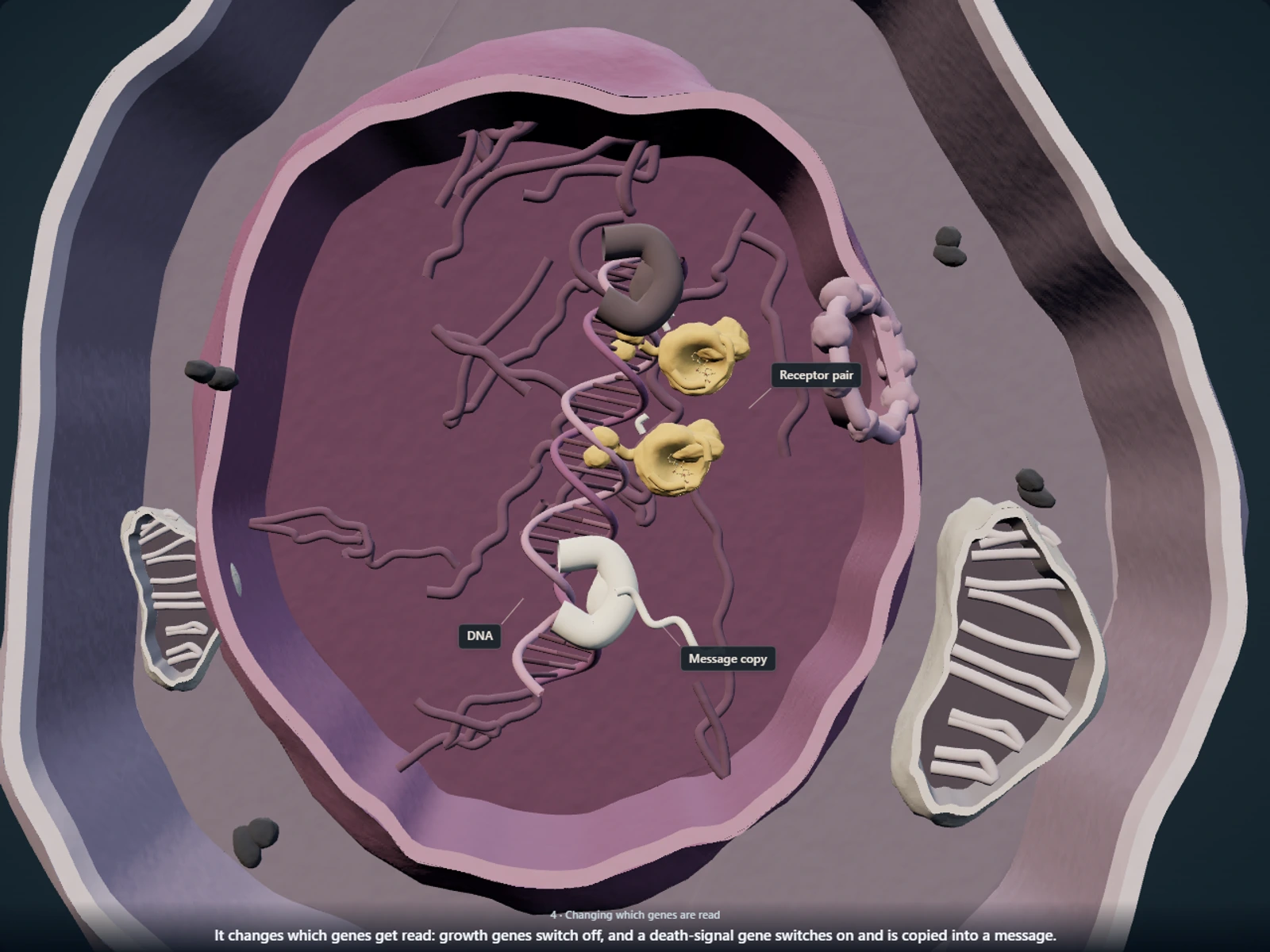
Lymphoblasts carry a receptor for steroids. When dexamethasone locks onto it, the pair moves into the cell’s nucleus and changes which genes the cell reads. For a leukemia cell, that switch turns on its own self-destruct program. Healthy cells with the same receptor mostly read the signal as “stress” and adjust rather than die.

I made an everyday analogy and a more scientific visualization of dexamethasone.

Everyday analogy

Dexamethasone is like a letter that tells a shop to close.

Dexamethasone is like a letter that tells a shop to close. A yellow-skinned shopkeeper works in an open bookshop. A blue postal car arrives. A yellow-skinned mail carrier opens the door, steps out, closes the door and walks to her with his mail bag. He takes out a teal letter and hands it to her. She opens it and lifts the instruction: Please close the shop. She reads, briefly looks surprised, then nods. She puts the same letter on the counter and pulls the shutter belt twice. The shutter lowers in response to each pull and stays closed. The view gently moves closer for the handoff, reading and belt pulls. The teal letter represents the medicine and the shutdown signal it can set in motion. The shop represents a leukemia cell. The shopkeeper following the letter represents the cell using its own machinery to activate its self-destruct process, not a temporary pause. This simplified scene shows a cell that responds to the medicine. AN EVERYDAY ANALOGY A letter that starts closing time OPEN CLOSED THE BOOKSHOP POST Pleaseclosethe shop. A mail carrier arrives with a teal letter for the shopkeeper. She opens the letter. It says, “Please close the shop.” She follows the instruction and closes the shop herself.

1 / 3 The instruction arrives

A mail carrier arrives with a teal letter for the shopkeeper.

  • The teal letter represents dexamethasone and the shutdown signal it can set in motion.

  • The shop represents a leukemia cell. The shopkeeper following the letter represents the cell using its own machinery to shut itself down.

  • Closing the shop represents the cell’s self-destruct process, not a temporary pause. This simplified scene shows a leukemia cell that responds to the medicine.

Press play below for a more accurate visualization.

Interactive visual

How dexamethasone changes gene reading and triggers leukemia cell death
Poster for How dexamethasone changes gene reading and triggers leukemia cell death
Read transcript

1. From blood to leukemia cell (0–10 seconds). Dexamethasone is a steroid that can be taken by mouth. After absorption, blood carries it to marrow and other tissues. The opened blood vessel contains red blood cells; gold dexamethasone molecules leave its wall toward the leukemia cell. Steroids are a core part of ALL treatment. Most B-ALL cells respond at diagnosis; some do not, or stop responding, which is why steroids are combined with other medicines. 2. Crossing the membrane (10–16 seconds). The close-up follows the same cell surface. Because dexamethasone is small and fat-loving, it dissolves between the membrane’s two oily leaflets and emerges inside. It needs no protein door. 3. A key changes the receptor (16–26 seconds). Helper proteins called chaperones hold the empty receptor folded and inactive. The drug enters its binding pocket. A domain swings over the pocket, the helpers release, and a nuclear-entry tag becomes exposed. The helpers stay in the cytoplasm; after release they have no further role in this story. 4. Changing which genes are read (26–38 seconds). The activated receptor passes through a hole in the nuclear envelope. A receptor pair binds a landmark on DNA. It changes gene reading without rewriting the DNA sequence. A reading enzyme moves beside the bound pair and a single-strand message separates; a neighbouring reader dims. One selected stretch represents a much larger gene program. 5. The mitochondrial death signal (38–48 seconds). Outside the nucleus a protein maker uses the message to build death-signal proteins. They settle on mitochondria, which release pale particles. Only after that release do the previously dim caspases brighten and spread. Chromatin condenses as the nuclear envelope breaks down. This depicts steroid-responsive leukemia cells. 6. Sealed packets, then cleanup (48–55 seconds). The dying cell has shrunk and darkened. Unequal small sealed packets separate as a larger, ruffled cleanup cell wraps and draws them into its interior. The sequence ends with cleanup; it never restores the living leukemia cell.

Side effects

The full list, kept up to date:

Where I read this