Written by a parent, not a doctor. Nothing here is medical advice.

Medicine

Doxorubicin

Updated September 2026.

Also known as: Adriamycin, anthracycline

Daunorubicin's cousin. Same red color, same job, counted toward the same lifetime total.

Doxorubicin is daunorubicin’s close cousin: the same family (anthracyclines), the same red color, the same job. The two differ by one small chemical group.

It slips between the rungs of the DNA ladder and traps topoisomerase II, the enzyme that cuts and reseals DNA so the cell can untangle and copy it. The cuts never get sealed, and a fast-dividing cell cannot cope with the damage and dies. Which of the two anthracyclines a protocol uses in a given block was decided by the people who designed the study; they are counted together as one lifetime total.

I made an everyday analogy and a more scientific visualization of doxorubicin.

Everyday analogy

Doxorubicin is like a wedge that stops a tailor sewing a seam closed.

Doxorubicin is like a wedge that stops a tailor sewing a seam closed.A seated tailor with yellow cartoon skin works on a rose-colored shirt. A magnified view shows the same seam, not a second shirt. She holds the sleeve while opening its seam with a seam ripper. She visibly sets down the ripper, picks up a threaded needle, brings the cloth edges together and sews them closed. She lifts brass dressmaking scissors, snips the thread, returns both tools to the bench and gives the repair a small, satisfied smile. She retrieves the ripper and opens the same seam again. After she moves the tool clear, a teal wedge drops into the already-open gap and settles there. Her eyes follow it and her expression changes. She exchanges the ripper for the needle and makes two careful attempts to close the seam; the needle meets the wedge and withdraws without passing through it. She sets the needle down and turns her empty hand upward. The wedge, open seam, tools and tailor remain visible in a held final scene. The teal wedge represents the medicine; the shirt represents DNA; the tailor is like the cell machinery that briefly cuts and rejoins DNA. This illustrates interference with rejoining, not every way the medicine works. THE WORKROOM A tailor’s work The same seam, closer. Sewn closed Still open Teal wedge = medicine The tailor opens a seam,then sews it closed. She opens the seam again.A teal wedge sticks in the gap. She tries to sew it shut,but the seam stays open.

1 / 3 Open, then sew closed

The tailor opens a seam, then sews it closed.

  • The teal wedge represents doxorubicin.

  • The shirt represents DNA, the cell’s instructions.

  • The tailor is like the cell machinery that briefly cuts and rejoins DNA. The wedge shows how doxorubicin can stop a cut from being rejoined.

  • This analogy shows one way doxorubicin works, not everything it does.

Press play below for a more accurate visualization.

Interactive visual

How doxorubicin wedges into DNA and jams the enzyme that reseals it
Poster for How doxorubicin wedges into DNA and jams the enzyme that reseals it
Read transcript

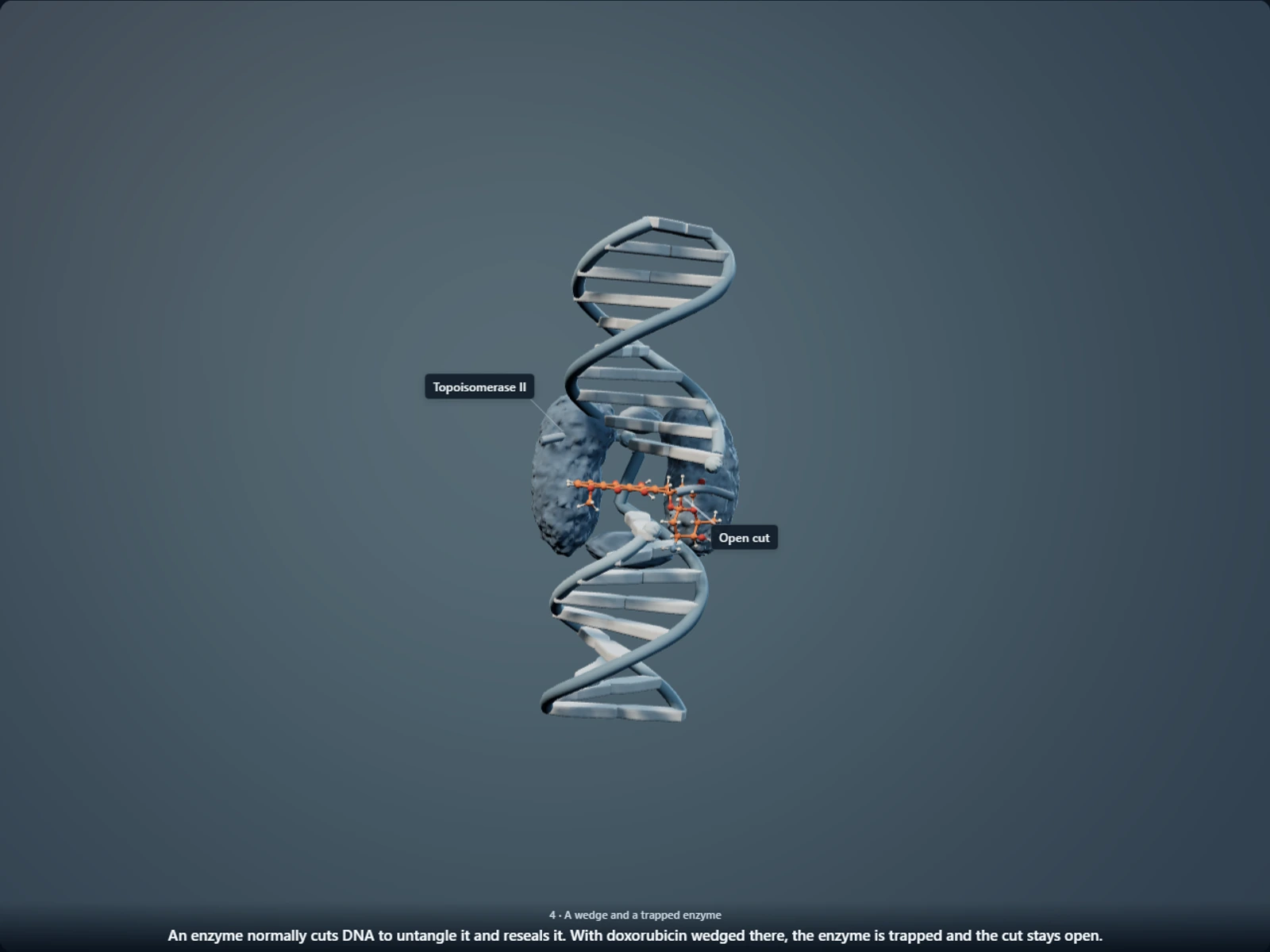
## 1. Arrival in the marrow (0–8 seconds) Doxorubicin is given into a vein. The blood carries it to leukemia cells in the bone marrow and wherever else they are. Leukemia cells divide fast, so they are always copying their DNA. That constant copying is the weakness doxorubicin attacks. ## 2. A flat core and a sugar arm (8–14 seconds) Doxorubicin has a flat, four-ring core and a small sugar arm. Its shape is the whole trick. ## 3. Into the nucleus (14–21 seconds) It is small enough to pass through the cell's membrane on its own, then through a pore into the nucleus, where the DNA is kept. ## 4. A wedge and a trapped enzyme (21–34 seconds) Its flat core slides between the rungs of the DNA ladder, like a card wedged into a deck. The sugar arm grips the groove. An enzyme normally cuts DNA to untangle it and reseals it. With doxorubicin wedged there, the enzyme is trapped and the cut stays open. ## 5. Copying stalls; self-destruct starts (34–44 seconds) The DNA-copying machine runs along the ladder and hits the trapped enzyme. Copying stalls, and the break cannot be repaired. Too much damage switches on self-destruct: the mitochondria leak, and dormant caspases wake and take the cell apart from inside. ## 6. Sealed packets and cleanup (44–52 seconds) The cell shrinks into many small sealed packets. The body's cleanup cells swallow them, and the leukemia cell is gone. This simplified sequence shows one cell undergoing apoptosis. Not all leukemia cells are copying DNA at the same time, damage can be repaired, and healthy cells can also be harmed. The molecule and cellular structures are enlarged for visibility.

Side effects

The full list, kept up to date:

Where I read this