
Pegaspargase (Oncaspar)
Updated September 2026.
Also known as: Oncaspar, PEG-asp
The standard long-acting asparaginase. Removes an amino acid leukemia cells depend on.
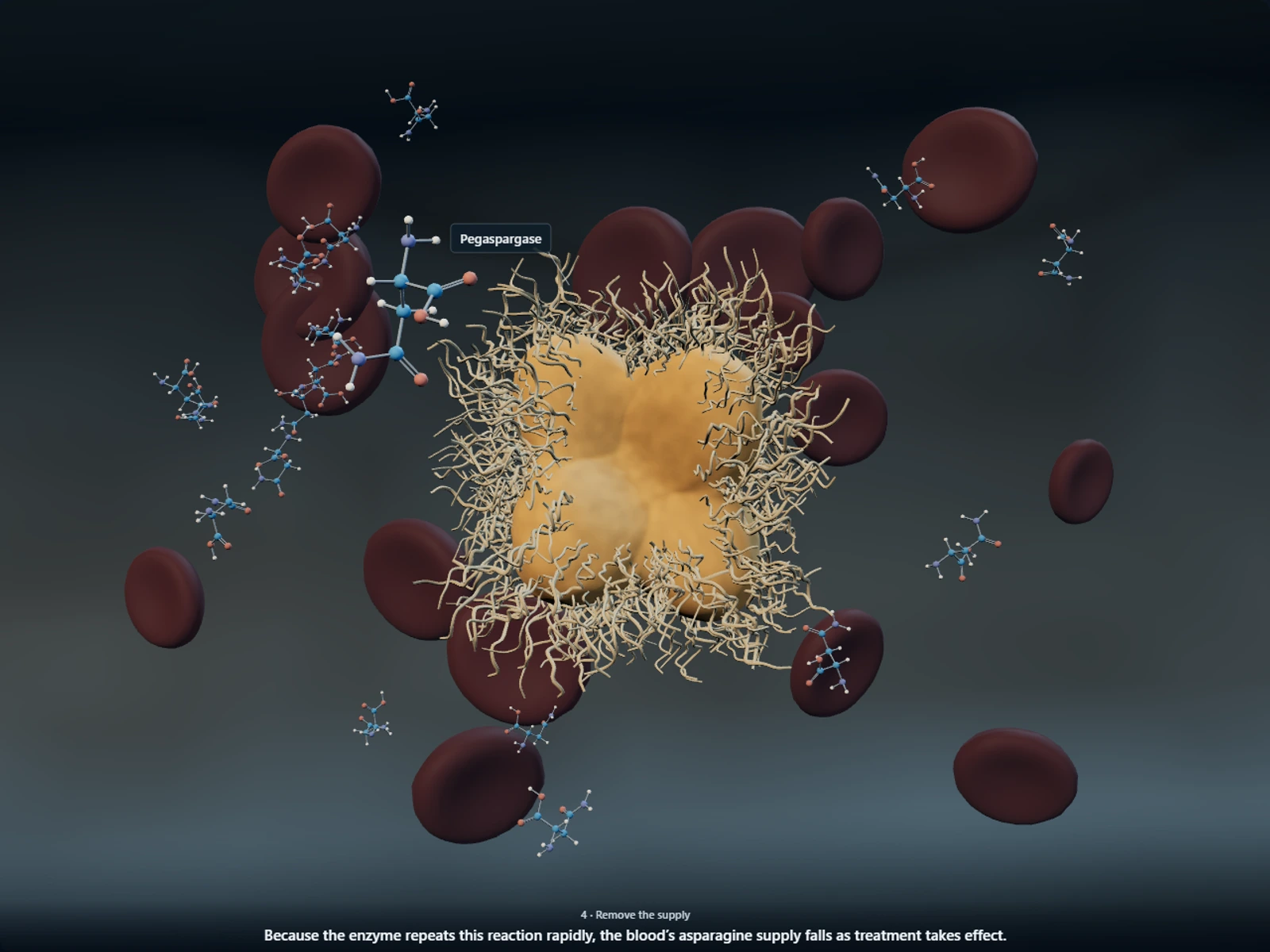
Pegaspargase (Oncaspar) is an asparaginase: an enzyme, not a chemical poison, given into a muscle or through the line. It circulates in the blood and breaks down asparagine, one of the amino acids every cell uses to build proteins.
Most healthy cells can make their own asparagine. Leukemia cells generally cannot make enough, so when the supply in the blood disappears they run out of a building block and die. The “peg” is a coat of polyethylene glycol wrapped around the enzyme; it hides the enzyme from the immune system and keeps it working in the blood for weeks rather than days.
I made an everyday analogy and a more scientific visualization of pegaspargase.
Everyday analogy
Pegaspargase is like breaking down the wheels a toy workshop needs.
1 / 3 Both makers finish cars
Delivered wheels help both makers finish little wooden cars.
2 / 3 Delivered wheels are broken down
The teal shredder breaks the wheels before they reach either workbench.
3 / 3 One can keep building
One maker can make more wheels. The other cannot finish the next car.
The teal shredder represents pegaspargase, which breaks down asparagine in the blood.
The wheels represent asparagine, a building block cells need to make proteins. The toy cars represent those proteins.
The bench with its own wheel maker represents cells that can make enough of their own asparagine.
The bench relying on deliveries represents leukemia cells that cannot make enough asparagine. Without enough, they struggle to make proteins and survive.
This is a simplified comparison. Pegaspargase can also affect healthy cells.
Press play below for a more accurate visualization.
Interactive visual
How pegaspargase starves leukemia cells of a building block they cannot make
Side effects
The full list, kept up to date:
- Pegaspargase — Together by St. Jude · written for families by a children's cancer hospital
- Pegaspargase injection — MedlinePlus · U.S. National Library of Medicine
Where I read this
- FDA prescribing information on DailyMed · section 12.1, mechanism of action
- Childhood ALL treatment (PDQ), National Cancer Institute · where each drug fits in treatment