Written by a parent, not a doctor. Nothing here is medical advice.

Medicine

Rylaze (Erwinia asparaginase)

Updated September 2026.

Also known as: Rylaze, Erwinia

Asparaginase from a different bacterium, used when a child reacts to the usual one.

Rylaze is an asparaginase too, but the enzyme comes from a different bacterium (Erwinia) instead of E. coli. It does the identical job: it circulates in the blood and breaks down asparagine, an amino acid that leukemia cells cannot make enough of for themselves, so they starve.

The immune system can learn to recognise and neutralise the E. coli enzyme, either with a visible reaction or silently, which is why teams check asparaginase blood levels. The Erwinia enzyme looks different enough to the immune system that it keeps working. It leaves the body faster, so it is given more often, usually as a shot into a muscle.

I made an everyday analogy and a more scientific visualization of Rylaze.

Everyday analogy

Rylaze is like breaking down the wheels a toy workshop needs.

Rylaze is like breaking down the wheels a toy workshop needs. Two yellow-skinned toy makers work at separate benches. Orange wooden wheels roll along a shared overhead conveyor and down supported chutes. Each maker picks up wheels and fits them to two wooden cars; the finished cars remain on the bench. A continuous close-up shows the teal shredder switching on and its guided blade breaking incoming wheels into pieces collected in a tray, before they reach either bench. Back in the workshop, the left maker reaches to the local wheel-press button with a bent elbow and a following wrist. A new wheel rolls out to the delivery cup and is fitted to the third car. The right maker checks the empty cup and the bare axle, then holds an empty hand beside the unfinished car. Both makers keep their feet planted. The scene ends with the third car finished on the left and still needing a wheel on the right. The wheels represent asparagine and the cars represent proteins; the accompanying page wording explains the comparison and its limits. Can make wheelsNeeds deliveries WHEEL MAKER OFFON Car finishedNeeds a wheelWheels are broken down before delivery.Every toy carneeds its wheels.Shared wheels Delivered wheels help both makers finish little wooden cars.The teal shredder breaks the wheels before they reach either workbench.One maker can make more wheels. The other cannot finish the next car.

1 / 3 Both makers finish cars

Delivered wheels help both makers finish little wooden cars.

  • The teal shredder represents Rylaze, which breaks down asparagine in the blood.

  • The wheels represent asparagine, a building block cells need to make proteins. The toy cars represent those proteins.

  • The bench with its own wheel maker represents cells that can make enough of their own asparagine.

  • The bench relying on deliveries represents leukemia cells that cannot make enough asparagine. Without enough, they struggle to make proteins and survive.

  • This is a simplified comparison. Rylaze can also affect healthy cells.

Press play below for a more accurate visualization.

Interactive visual

How Rylaze keeps stripping asparagine from the blood after the immune system has learned to block the first asparaginase
Poster for How Rylaze keeps stripping asparagine from the blood after the immune system has learned to block the first asparaginase
Read transcript

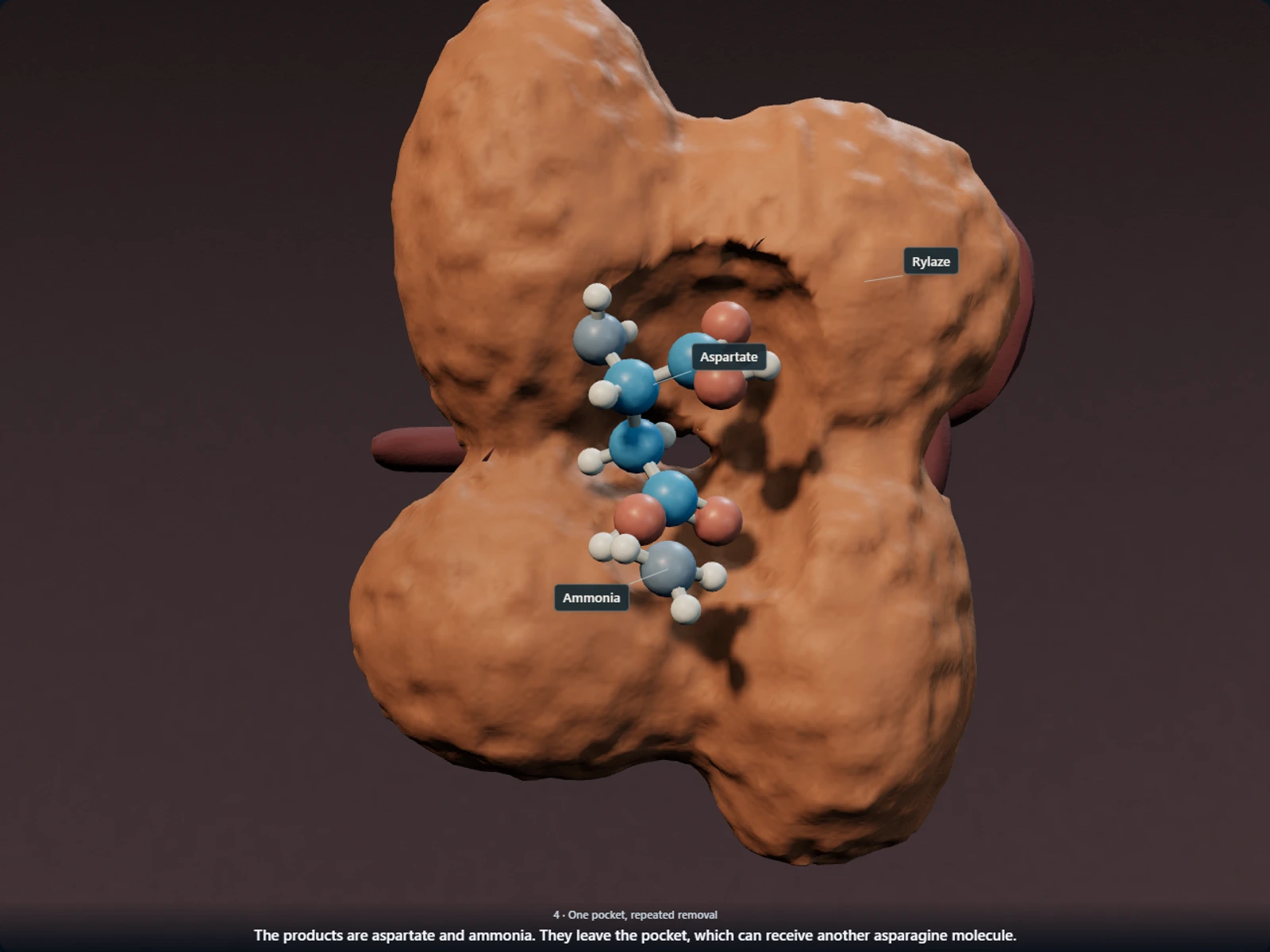
92-second narrated visual. ## When antibodies reduce activity (0–12 s) Antibodies can reduce the first asparaginase’s activity, so asparagine remains available to cells that need it for protein building. ## A different surface (12–24 s) Rylaze has a different bacterial protein surface, so it can replace E. coli asparaginase after hypersensitivity. Allergic reactions remain possible. ## Asparagine docks (24–34 s) Asparagine fits into a working pocket on Rylaze, so the enzyme can change this building block outside cells. ## One pocket, repeated removal (34–62 s) 34 s: In this working pocket, water helps split asparagine. Follow the larger molecule and the small fragment as they separate. 42 s: The products are aspartate and ammonia. They leave the pocket, which can receive another asparagine molecule. 52 s: Repeating this reaction lowers the blood’s asparagine supply. Many reactions and much longer biological time are compressed here. ## Protein building stalls (62–80 s) 62 s: Without enough asparagine, leukemia-cell protein building stalls. This normal cell keeps building because its own asparagine maker supplies it. 72 s: Sustained shortage can trigger death: mitochondria release signals, so caspases activate and the nucleus breaks apart. ## Sealed packets and cleanup (80–92 s) The dying leukemia cell shrinks into sealed packets, so a cleanup cell can engulf them. The illustrated normal cell remains intact.

Side effects

The full list, kept up to date:

Where I read this