Written by a parent, not a doctor. Nothing here is medical advice.

Medicine

Thioguanine (6-TG)

Updated September 2026.

Also known as: 6-TG, Tabloid

Mercaptopurine's sibling; fakes a DNA building block. Used in short bursts in some protocols.

Thioguanine (6-TG) is mercaptopurine’s sibling, from the same family (thiopurines). It is a pill. Mercaptopurine has to be converted inside the cell into thioguanine nucleotides before it can do anything; thioguanine already is one, so it gets into the DNA more directly.

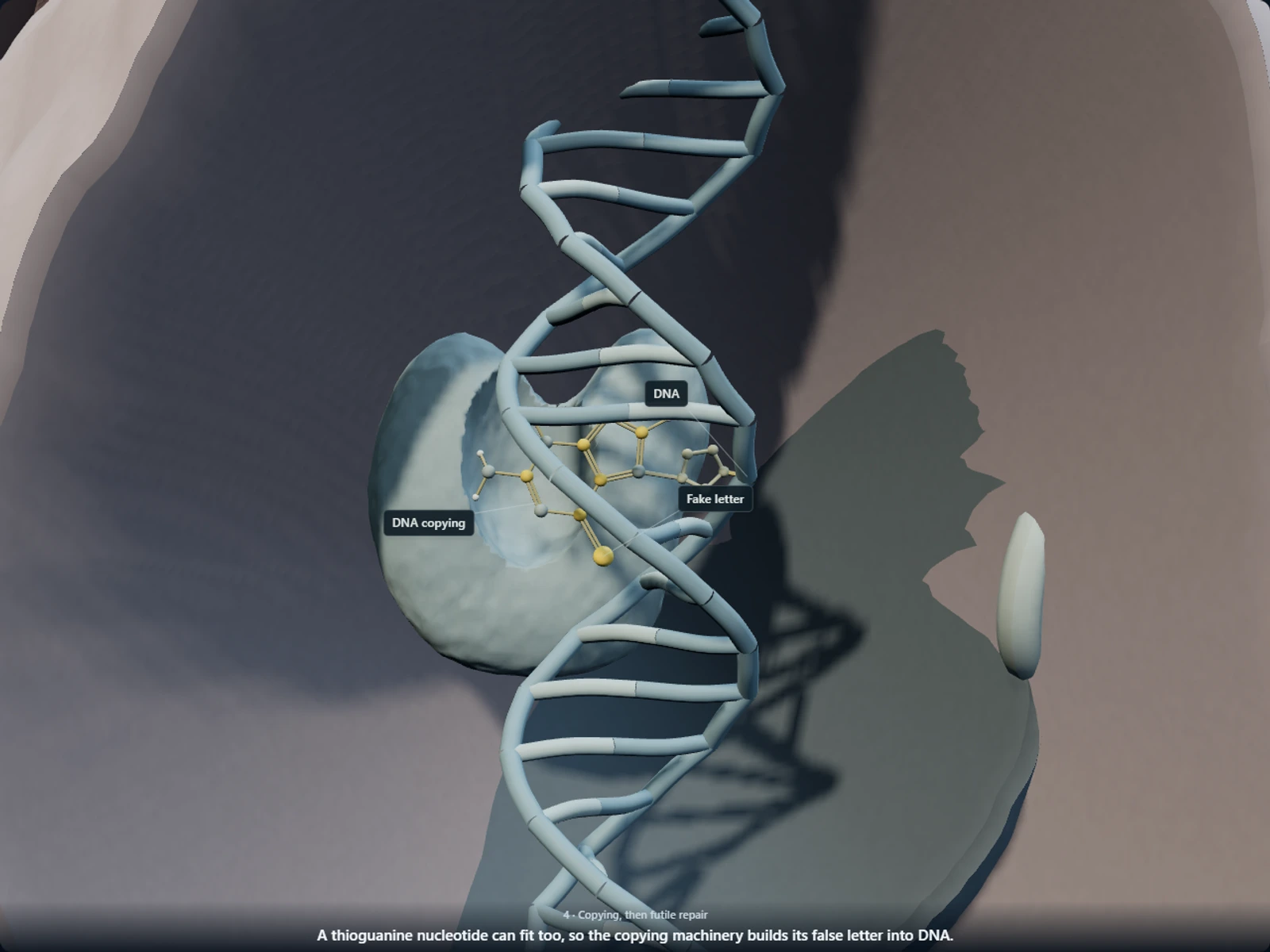
The rest of the story is the same. The fake building block is built into the DNA copy, the cell’s proofreading system cannot repair it, and after repeated failed repairs the cell dies. Some protocols use it in short bursts rather than every day for years the way mercaptopurine is used; your roadmap says whether yours is one of them.

I made an everyday analogy and a more scientific visualization of thioguanine.

Everyday analogy

Thioguanine is like faulty bricks that stop a building project.

Thioguanine is like faulty bricks that stop a building project. An everyday analogy for one part of how this medicine works. A yellow-skinned builder supports an ordinary brick with both hands, lifts it and seats it in an unfinished brick wall. The builder reaches for a teal brick on a workbench, lifts it, brings the other hand underneath, steps closer and seats it beside the ordinary brick. Several teal bricks are already in the wall. Cracks appear in them; the builder notices the damage and walks back. A yellow-skinned inspector approaches, studies the wall, writes a cross on a clipboard, returns the pencil to its holder and raises a hand to stop the work. The inspector steps back beside the builder. A yellow-skinned operator drives a bulldozer in from the right and lowers its blade. The empty building is pushed down; its original bricks remain visible in the settled rubble. Everyone stays outside the demolition area and the final scene holds. Bricks represent DNA building blocks; teal bricks represent faulty building blocks formed from the medicine inside a cell. Building work represents copying DNA so a cell can divide. The inspector and demolition simplify growth stopping and a damaged cell dying; they are not extra medicines or an immune-cell attack. This analogy shows one part of how the medicine works, with the detailed scientific visualization provided separately. REJECTED One building. Many bricks.Faulty bricks put the project at risk.Work stops. The building comes down. Faulty bricksBuild with faulty bricksReject the damaged buildingStop and take it down

1 / 3 Build with faulty bricks

Build with faulty bricks

  • Teal bricks = faulty DNA building blocks formed when thioguanine is changed into active forms inside a cell.

  • Bricks = the building blocks used to make DNA, the cell’s instructions.

  • Building work = copying DNA so a cell can divide. Faulty blocks can disrupt copying and stop a cell dividing.

  • The inspector’s decision and demolition = growth stopping and a damaged cell dying, not extra medicines or an immune-cell attack. This shows one part of how thioguanine works.

Press play below for a more accurate visualization.

Interactive visual

How thioguanine is built into leukemia-cell DNA and why the cell's proofreader cannot fix it
Poster for How thioguanine is built into leukemia-cell DNA and why the cell's proofreader cannot fix it
Read transcript

## 1. From gut to blood (0–8 seconds) Because thioguanine crosses the gut lining, blood carries the absorbed drug onward. ## 2. A close resemblance (8–22 seconds) Blood brings thioguanine to this leukemia cell. A transporter helps the drug cross its outer membrane. Thioguanine resembles guanine, a normal DNA letter, but has sulfur where guanine has oxygen. ## 3. The cell activates it (22–44 seconds) Inside the cell, thioguanine docks in an activating enzyme called HGPRT. HGPRT attaches a sugar with one phosphate, making the first thioguanine nucleotide. Further processing adds two phosphates and prepares the sugar for DNA. The sulfur-marked base stays the same. The prepared nucleotide passes through a nuclear pore to reach the DNA inside. ## 4. Copying, then futile repair (44–79 seconds) A cell copies DNA by joining matching letters into a new strand. Watch normal letters join first. Each incoming letter joins the growing strand. The original strand guides which letter fits. A thioguanine nucleotide can fit too, so the copying machinery builds its false letter into DNA. After further chemical changes and later copying, the altered letter can pair incorrectly, creating a mismatch. Repair removes a stretch of the opposite strand. The altered letter stays in the original strand. Refilling can recreate the mismatch. Repeated repair can leave gaps and trigger a damage response. ## 5. Dismantling from within (79–90 seconds) In this example, DNA damage starts cell self-destruction. Mitochondria release signals that activate caspases. Caspases dismantle the cell from within. Its nucleus breaks up as the cell begins packaging its contents. ## 6. Sealed and cleared (90–101 seconds) The dying cell shrinks into small sealed packets. A macrophage wraps around and engulfs the packets, clearing away the remains.

Side effects

The full list, kept up to date:

Where I read this